

Bring out the leader in you
Published: September 13, 2010
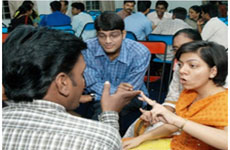 A person being interviewed for an entry or mid-level profile is checked for the leadership competencies relating to the future.
Leadership skills are today considered a part and parcel of the much talked about soft skills or communication skills. Probably, the essence of leadership skills is embedded in the quote: “Leaders don't wait. They shape their own frontiers. The bigger the challenge, the greater the opportunity.”
Experts say that soft skills are nothing but a cluster of personality traits, and leadership skills form an important part in that cluster.
Ten years ago, the word ‘soft skill' was little known, but today it is a phenomenon, and it competes on an even platform with hard skills or intelligent quotient. To succeed in life — whether to get a good campus job or to join a top institute for higher studies or for that matter doing well in a multi-cultural job environment, leadership skills play a vital role.
“The most important quality of a leader is to give extraordinary performance with the goal of achieving extraordinary results, which serve as an inspiration to others. This is only possible through split-second decision-making, a risk people are not willing to take as we are governed by statements such as “haste makes waste,” “look before you leap,” “stop and think” and “don't judge a book by its cover,” says communication skills trainer and director of CTC Communications A.S. Prasad.
Organisations across the world are looking only for leaders. A person being interviewed today for an entry or mid-level profile is being checked for the leadership competencies relating to the future, he points out
Change is the only thing that is constant and the world today is changing at a very fast pace. The only two options available are either to become a leader of change or a victim of circumstances,” he says.
Another personality trainer, P.V. Rama Sasank points out, “There is a misconception that group discussion held during an interview process is an elimination round. It is not an elimination round but rather a selection round that checks on the leadership qualities of a person.”
Adding to Mr. Sasank's observation, Mr. Prasad says, “Group discussion and group tasks are tools used to evaluate a candidate's leadership profile.”
Quoting a real-life case, he says, “In a recent recruitment drive by a major MNC, candidates were divided into sets of five and given a joint group task to execute (usual process in an SSB). In one group, one individual from the group completed the task well within the stipulated time whereas the other four did it equally well but beyond the stipulated time. Any guess who was selected? The entire group was a wash-out, with the first being rejected on the basis of not having the capacity to operate in a team or leading a team and the rest four for lacking the capability of absorbing the first person's expertise into the team.”
Leadership skills are to be imbibed during the graduation days. Here are a few tips given by Mr. Prasad: At the entry level the only way to show that an individual possesses leadership qualities is to prove that he has the capacity to be a part of the team. This is possible only by showcasing experiences from real life, where the individual had been an active part of the team. If the experiences do not already exist, it is advisable to start building experiences through active participation in team games, cultural activities at college and societal levels and by actively participating in college events.
In most cases, a person trying to enter a team would encounter the difficulty of becoming a part of the team, as the issue of acceptability rears it ugly head. The skill-set required to enter a team could be answered by the question, “Are leaders made or born?” The social skill sets play an important role in such a situation. Likes and dislikes can only be developed by exhibiting excellent observation and listening skills and the ability to connect with the environment and the people around you.
Social skills can be developed only by evincing keen interest in the people and the environment around you, coupled with an understanding
of social responsibilities and values.
in Visakhapatnam